My Talking Tom Friends 2
- 4.4
- Rating
- 50.00M
- Installs
- Free
- Price
 Analysis by App-foxy
I expected a light virtual-pet game, but My Talking Tom Friends 2 works best when I treat it as a small, flexible break rather than a game that demands a long commitment. I can open it, spend a few minutes checking in with Talking Tom and the other characters, try a mini game, and leave without feeling that I have abandoned a complicated campaign. That immediate accessibility is its biggest strength.
It is a free casual game from Outfit7 Limited, rated for Everyone, and it has already found a broad audience with an average rating of 4.6 from around 120 thousand ratings and over 10 million installs. Those figures make sense after using it: the presentation is friendly, the basic idea is easy to understand, and the game is built around familiar virtual-pet routines rather than difficult rules or a demanding story.
Still, the relaxed format has a trade-off. If I want deep strategy, a carefully structured adventure, or a strong sense of long-term progression, this is not the right destination. Its pleasure comes from short interactions, simple activities, and the feeling of visiting a lively group of digital companions. The question is not whether it can keep me busy for hours, but whether it makes a five-minute visit feel worthwhile.
You May Also Like

 Blood Strike: 2.5 Anniversary
Blood Strike’s Loadouts Turn Every Drop Into a Tactical Gamble
A close look at Blood Strike’s custom loadouts: how fast access to signature weapons reshapes its battle royale rhythm, rewards preparation, and narrows the gap between fights.

 Pandora - Music & Podcasts
Pandora’s Music Is Easy to Start, but Harder to Recover
Pandora’s strength is its low-effort path from a seed to a station. Its weak spot is how much confidence it asks you to place in connection, setup, and quiet recovery.

 8 Ball Pool
 Is Built on Rivalries, Rematches, and Routine
A close look at the rivalries, rematches, shared routines, and unanswered safety questions that turn a quick pool match into a persistent mobile community.

 Samsung Music
’s Quiet Strength Is Playing What You Already Own
Its reach comes less from spectacle than from dependable access to a personal library. That simplicity is both the app’s strongest retention engine and its ceiling.

 AccuWeather: Weather Radar
AccuWeather Review: A Quick, Clear Forecast for Everyday Decisions
For everyday plans, the best forecast is the one you can understand quickly. AccuWeather makes rain timing, radar, and local conditions easy to act on, with a few trade-offs.

 Hill Climb Racing
Why Hill Climb Racing Still Turns Crashes Into One More Run
A tiny car, a bumpy hill and one more upgrade: Hill Climb Racing keeps resurfacing because its simple chaos makes every near-miss feel personal.
More From Our News Desk
View All News


Why the first few minutes work so well
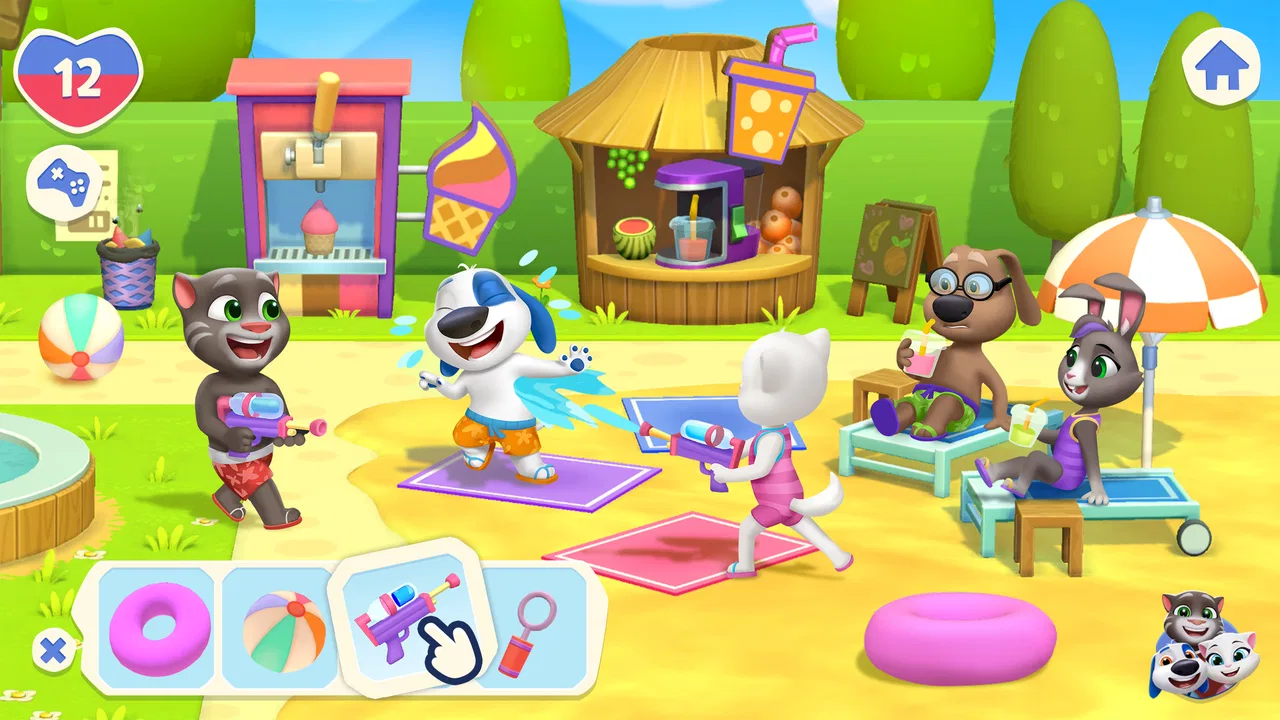
The central appeal is easy to grasp: I spend time with Talking Tom and friends, look after virtual pets, and move between playful activities. There is no complicated setup to learn before the game becomes enjoyable. The characters provide the immediate focus, while the mini games give me something active to do when simply checking on the pets is not enough.
That combination gives the opening moments a useful rhythm. I can begin with a quick visit, notice what the characters are doing, and then decide whether I want a quieter interaction or a more game-like distraction. In many casual games, the first session is overloaded with instructions, menus, and rewards. Here, the appeal is more direct: the characters are the reason to stay, and the activities are there to support that visit.
I also like that the game does not require me to approach it as a serious challenge. A child can understand the playful premise, while an adult can use it as a low-pressure way to fill a short wait. The Everyone rating fits that tone. It feels designed to be approachable rather than intimidating, and the friendly cast does much of the work that a complex tutorial would normally handle.
The title can be confusing at a glance because the store short description identifies it simply as My Talking Tom 2, while the game is presented as My Talking Tom Friends 2. Once I focus on the actual experience, the important distinction is the group dynamic: this is not only about checking one virtual pet. The presence of friends makes the visit feel more like a shared household of characters, even though the activities remain deliberately simple.
A short session has a clear shape
My most enjoyable sessions follow a three-part pattern. I start by checking the characters, move into one or two activities, and then stop when the novelty of that visit has faded. This is a better way to play than expecting a conventional level-based game to carry me forward continuously. The design feels more comfortable in small portions than in marathon runs.
That matters in everyday use. If I am waiting for a bus, taking a break between tasks, or looking for something gentle before bed, I do not need to remember a complicated objective. I can open the game and make a decision almost immediately. The lack of pressure is valuable because I am not punished for treating it as a brief social visit rather than a full gaming session.
The mini games are especially useful when I want immediate input instead of passive pet care. They give the session a little shape and help prevent the experience from becoming only a sequence of routine checks. However, I would not choose this game expecting the mini games to replace a dedicated arcade collection. Their role is to add variety to the virtual-pet loop, not to deliver the depth or precision of a specialist game.
One practical tip is to avoid trying to complete every available interaction whenever I open the app. The game becomes more pleasant when I choose one small goal for the visit, such as spending time with the characters or playing a quick activity, and then leave. That approach preserves the sense of spontaneity and makes returning later feel less like repeating chores.
When interruptions are part of the design
This is where the game performs better than many casual alternatives. A virtual pet can easily become demanding if it expects constant attention, while a mini-game collection can make a player feel that every session should be productive. This title sits between those styles. I can interrupt a visit without losing the main reason I opened it in the first place: a few moments with familiar characters.
That does not mean every return feels equally fresh. The game depends on the charm of its cast and the small variations in what I decide to do. If I play repeatedly in exactly the same order, the routine can become predictable. The best use is therefore flexible: check in when I want a gentle distraction, but do not force a long session just because the game is open.
For families, that pause-friendly structure can be useful. A child may want to play briefly and then put the device down for another activity. The game does not need to become the center of the day to feel satisfying. I would still recommend that an adult review the purchase settings before handing over a device, because the game is free to start but includes optional in-app purchases ranging from about five dollars to about seventeen dollars per item.
That pricing range is one of the main points I would discuss with a parent. The free entry makes it easy to try, but a child may not naturally distinguish between ordinary play and an optional purchase. The safest routine is to establish expectations before play begins and treat paid items as a separate decision, not as a normal part of every visit.
Returning later: comfort versus repetition
The strongest reason to come back is familiarity. Talking Tom and the other characters are recognizable, and the virtual-pet format makes returning feel like checking in on a small digital household. That is a different kind of replay value from unlocking a new story chapter or mastering a competitive ranking. I return because the interaction is comfortable and immediately understandable.
The weakness is that comfort can turn into repetition. Once I know the general loop, surprise is no longer the main reward. The game needs me to vary my attention between the characters and the mini games, rather than expecting one activity to remain exciting indefinitely. If I want constant discovery, I will probably outgrow the experience faster than someone who enjoys familiar routines.
A useful way to keep the loop from feeling automatic is to change the purpose of each visit. Sometimes I can focus on the pets and their reactions; at another point I can open the game specifically for a mini game; on another return I can simply spend a short moment with the group and close it. This does not transform the game into a deep progression system, but it makes the limited session length feel intentional.
I also find that the game suits people who prefer soft goals over hard targets. There is no need to chase a perfect performance every time I play. That makes it less stressful than many score-focused casual games, but it also means that players who need clear achievement milestones may find the motivation too loose. The same simplicity that helps a newcomer can leave an experienced player wanting more structure.
How it compares with other casual choices
Compared with a traditional single-pet simulator, the group of characters gives this game a broader social feeling. I am not returning to one pet alone; I am visiting a cast. That makes the experience more varied at the emotional level, even when the underlying actions remain easy. Someone who likes the personality of the Talking Tom universe will likely get more from this setup than from a generic pet-care app.
Compared with a dedicated mini-game collection, however, it is clearly less focused on challenge. The mini games are part of a larger virtual-pet experience, so I would not choose this title if my priority were precise controls, escalating difficulty, or a large catalogue of standalone challenges. A pure arcade game is a better fit for a player who wants to keep improving at one mechanic.
It also differs from more demanding life-simulation games. Those alternatives may offer more systems to manage, more detailed customization, or a stronger sense of building something over time. My Talking Tom Friends 2 is easier to enter and easier to leave, but that convenience comes at the cost of depth. I think of it as a friendly pocket activity, not as a substitute for a full simulation.
The free price is another reason it works as a trial. I can see whether the characters and short-session loop appeal to me before committing money. On the other hand, the optional purchases mean the free starting point should not be confused with an entirely purchase-free experience. For a player who wants a clean, uninterrupted game with no temptation to spend, a paid alternative may be more comfortable.
Device and version details worth knowing
The current version is 26.2.0.24958, and the game supports devices running Android 6.0 or later. That makes it relevant to people who are not using the newest phone, although actual comfort will still depend on the device and how smoothly it handles the game. I would install it on the device where I expect to play most often, rather than assuming that an older phone will provide the same responsiveness as a newer one.
Because the game is built for quick visits, responsiveness matters more than it might in a slow strategy title. If opening the game or moving through activities feels sluggish on a particular device, the short-session advantage becomes less valuable. A few seconds of friction has more impact when the intended visit is only a few minutes. That is an important practical consideration for anyone using an older Android phone.
I would also think about the setting in which the game will be used. Its casual tone makes it suitable for waiting rooms, travel breaks, and quiet downtime, but the character-focused presentation may not appeal to someone looking for a discreet, text-heavy game. It is visibly playful and intentionally expressive. That is part of its identity, not a flaw, but it narrows the audience in a useful way.
Who will enjoy it, and who should skip it
I recommend it most readily to players who like virtual pets, recognizable characters, and activities that can be enjoyed without a long tutorial. It is a good fit for a child-friendly household, for someone who wants a gentle game between tasks, or for a fan of Talking Tom who enjoys seeing the wider group together. The short-session structure also suits people who dislike games that demand daily concentration or long uninterrupted play.
I would be more cautious if the player is motivated by mastery. Someone who wants competitive scoring, complex planning, or a campaign with meaningful strategic decisions will probably find the experience too light. The same applies to players who become frustrated by repeated routines. The game offers variety through its cast and mini games, but it does not turn every return into a major new challenge.
It is also not my first recommendation for anyone who wants to avoid in-app purchase prompts entirely. The game can be enjoyed as a free experience, but the presence of optional items changes the way I would introduce it to a child. Setting a clear spending boundary is part of using it responsibly, especially when the characters make the game feel welcoming and personal.
For an everyday example, I can imagine opening it during a ten-minute break after finishing a household task. I check the group, choose a mini game, enjoy the quick change of pace, and close it before the break turns into an hour of aimless scrolling. That is the ideal scenario: the game gives me an immediate lift without asking me to remember a plot or prepare for a difficult challenge.
My casual verdict
After spending time with it, I see My Talking Tom Friends 2 as a polished example of a short-session virtual-pet game. Its immediate pleasure comes from the characters, its practical strength is that I can pause and return easily, and its replay value depends on whether I enjoy familiar routines more than constant novelty. It does not pretend to be a deep adventure, and I would not judge it by that standard.
The game is at its best when I use it in small portions: a quick check-in, a mini game, or a few relaxed moments with the virtual pets. The main limitations are equally clear. Repetition can arrive if I follow the same routine every time, and optional purchases deserve attention when children are playing. Players seeking demanding mechanics should choose a more specialized casual game instead.
For everyone else, the free entry makes trying it straightforward, and the Everyone age rating supports its approachable tone. I would recommend it to a friend who wants a cheerful game that tolerates interruptions and delivers something pleasant almost immediately. I would describe it honestly, though: this is a companion game for brief visits, not a title I would install for deep progression or endless challenge. Its success comes from making a small amount of play feel easy to start and easy to stop.
FAQs for My Talking Tom Friends 2
01What is My Talking Tom Friends 2 about?
My Talking Tom Friends 2 is an engaging virtual pet simulation game where players can interact with Talking Tom and his friends. The game allows you to care for these characters, play mini-games, and decorate their home. It’s designed for users of all ages, offering a fun and interactive experience with delightful graphics and sound effects.
02Is My Talking Tom Friends 2 free to play?
Yes, My Talking Tom Friends 2 is free to download and play on both Android and iOS devices. However, the game offers in-app purchases for users who want to enhance their gaming experience with additional items or features. These purchases are optional, and the game can be enjoyed without spending money.
03What are the system requirements for My Talking Tom Friends 2?
To run My Talking Tom Friends 2 smoothly, you'll need a device with Android version 5.0 or higher, or iOS 10.0 or later. Ensure your device has enough storage space for the app and any additional content updates that may be released, to enjoy uninterrupted gameplay.
04Can I play My Talking Tom Friends 2 offline?
My Talking Tom Friends 2 requires an internet connection for certain features, such as downloading content updates and participating in online events. However, many aspects of the game can be enjoyed offline, including interacting with characters and playing some mini-games, making it accessible even without constant internet access.
05Is My Talking Tom Friends 2 safe for children?
My Talking Tom Friends 2 is designed to be child-friendly, with content appropriate for younger audiences. The game includes parental controls to manage in-app purchases and screen time. Additionally, the developers prioritize user safety and regularly update the app to ensure a secure environment for all players.
Pros
- Engaging gameplay for all ages.
- Variety of mini-games included.
- Customizable pet features.
- Regular updates with new content.
- Offline mode available.
Cons
- Contains in-app purchases.
- Ads can be intrusive.
- Requires large storage space.
- Limited parental controls.
- May drain battery quickly.

My Talking Tom Friends 2
Gallery